
India’s CBG Blending Obligation 2026 requires the notified CBG obligation to reach 3% of total CNG used in transport and PNG supplied to domestic households during FY 2026–27. The obligation is intended to create predictable demand for compressed biogas within City Gas Distribution networks. For CBG developers, however, the 3% mandate should be treated as a national demand signal—not as a guarantee that every proposed plant will automatically receive an offtake agreement, pipeline connection or commercially viable delivery point.
The practical opportunity depends on feedstock security, gas quality, the local CGD network, evacuation distance, contracting arrangements and the project’s ability to produce consistently. This guide explains the notified blending trajectory, who it affects, how it can influence project planning and which questions an investor should resolve before committing capital.
What Is the CBG Blending Obligation in India?
The CBG Blending Obligation, also referred to in recent government communication as the CBG Obligation or CBO, is a phased requirement designed to increase the use of compressed biogas in selected City Gas Distribution segments. It applies to CNG used for transport and PNG supplied to domestic households.
The National Biofuels Coordination Committee approved the phased programme in November 2023. According to the official PIB announcement on the CBG Blending Obligation, the programme remained voluntary through FY 2024–25 and became mandatory from FY 2025–26. A Central Repository Body is responsible for monitoring and implementation under the approved operational framework.
Important scope: The notified percentages relate to total CNG consumption in the transport segment and PNG consumption in the domestic segment. The announcement does not describe the obligation as a universal percentage applicable to every industrial gas consumer, every pipeline or every individual retail transaction.
CBG Blending Obligation 2026: What Is the Current Target?
For FY 2026–27, the notified CBG obligation is 3%. It rises to 4% in FY 2027–28 and 5% from FY 2028–29 onward. The gradual trajectory is intended to allow CBG production, procurement and delivery infrastructure to expand alongside mandatory demand.
| Financial year | Notified CBG obligation | Status |
|---|---|---|
| Up to FY 2024–25 | Voluntary | Pre-mandatory phase |
| FY 2025–26 | 1% | Mandatory phase begins |
| FY 2026–27 | 3% | Current notified target |
| FY 2027–28 | 4% | Next scheduled increase |
| FY 2028–29 onward | 5% | Long-term notified level |
The August 2026 unified GOBARdhan announcement retained this trajectory and linked procurement by CGD entities with an offtake-assurance framework. The official GOBARdhan scheme explainer describes the obligation as a long-term demand signal intended to improve capacity utilisation, project bankability and private investment.
Which Gas Segments Are Covered by the 3% CBG Mandate?
The notified obligation covers two defined segments within the CGD system: CNG for transport and PNG for domestic use. This distinction matters when estimating the addressable market for a proposed plant.
| Gas segment | Included in notified CBO? | Planning relevance |
|---|---|---|
| CNG for transport | Yes | Creates CBG demand linked to vehicle-fuel consumption in CGD networks |
| PNG for domestic households | Yes | Connects the obligation with household piped-gas demand |
| Industrial PNG | Not identified in the original notified CBO scope | Any sale requires a separate applicable commercial and regulatory route |
| Commercial PNG | Not identified in the original notified CBO scope | Do not include automatically in CBO demand calculations |
| Direct sale outside CGD | Not created merely by the CBO | Requires its own buyer, delivery model and compliant contract |
A developer should therefore obtain location-specific information instead of applying 3% to all natural-gas consumption in a district. Useful inputs include the relevant CGD geographical area, authorised entity, eligible CNG and domestic PNG demand base, available injection or receiving point, distance from the site and the buyer’s procurement process.
How Does the 3% Obligation Affect CBG Demand?
The increase from 1% to 3% means the scheduled obligation for FY 2026–27 is three times the previous year’s percentage. At the system level, this can expand the quantity of CBG that CGD entities need to procure for the covered segments. At an individual-project level, the resulting opportunity depends on how procurement is allocated and whether the plant can satisfy technical and commercial conditions.
Demand visibility can support the sector in four ways:
- Stronger offtake signal: A mandatory trajectory gives producers and lenders a clearer view of future market demand than a purely voluntary programme.
- Longer planning horizon: The progression to 5% from FY 2028–29 allows capacity and feedstock supply chains to be planned over multiple years.
- Greater focus on connectivity: More CBG demand increases the importance of pipeline injection, compression, cascade transport and receiving infrastructure.
- Higher value of reliable operations: Buyers need consistent quantity and compliant quality, making stable digestion and gas upgrading commercially important.
India’s CGD system has also expanded substantially. A June 2025 government energy overview reported coverage across 307 geographical areas and more than 7,700 CNG stations. These national figures demonstrate market scale, but they should not substitute for local demand and connectivity data when evaluating a site.
Illustrative CBG Demand Calculation for Project Screening
A simple calculation can help a developer understand the scale of the obligation in a defined market. It is only a preliminary screen and must not be treated as a confirmed allocation or purchase commitment.
Illustrative formula: eligible annual CNG transport and domestic PNG consumption × applicable CBG obligation percentage = indicative obligation-linked CBG quantity.
Illustrative example only: Assume a relevant demand pool contains 100 units of eligible CNG transport and domestic PNG consumption during FY 2026–27. Applying the 3% obligation gives an indicative requirement of 3 equivalent units of CBG. This does not mean a proposed plant is entitled to supply those units. Actual procurement can depend on aggregation, measurement basis, contracts, network capacity, quality, delivery point and implementation rules.
Before converting a gas-demand figure into tonnes of CBG per day, the project team should confirm the official measurement basis, calorific-value treatment, methane specification, delivery conditions and time period used by the relevant buyer. Mixing volumetric, energy and mass units without correct conversion can materially distort a feasibility assessment.
Does the CBG Obligation Guarantee Offtake for a New Plant?
No. The obligation supports aggregate market demand, but a new plant still needs a valid route to market. An investor should distinguish between a policy-level demand requirement and a project-specific, enforceable offtake arrangement.
A credible project should validate:
- the authorised CGD entity or other eligible buyer for the project location;
- whether procurement is through pipeline injection, cascade delivery or another approved mechanism;
- the proposed quantity, tenure, pricing basis, taxes and payment conditions;
- gas quality, pressure, metering and testing requirements;
- the injection, receiving or dispensing point and who funds the connection;
- responsibility for compression, transport, balancing, rejection and downtime;
- documentation and milestones required before commercial supply begins.
The unified GOBARdhan scheme also announced assured offtake, administered pricing, capital assistance, pipeline infrastructure, credit support and technology development. For the wider framework, read Biofics’ GOBARdhan Scheme 2026 guide. Each benefit must still be evaluated under the applicable guidelines and project documents.
What Must a CBG Plant Deliver to Participate Reliably?
A policy mandate creates demand, but plant engineering determines whether supply can be sustained. Capacity should be based on secure feedstock and realistic methane potential—not on the size of a theoretical market alone.
1. Year-round feedstock security
The plant needs verified daily quantities, composition, contamination levels, moisture, seasonal variation, collection radius and delivered cost. Napier grass, press mud, cattle dung, food waste and agricultural residues behave differently in storage, pre-treatment and anaerobic digestion.
2. Stable biological production
Feed preparation, organic loading, retention time, temperature, mixing and process monitoring affect raw-biogas production. A plant sized around optimistic feedstock yields may fail to maintain contracted CBG supply.
3. Compliant gas upgrading and verification
Raw biogas must be cleaned and upgraded before compression or injection. Methane concentration, carbon dioxide, hydrogen sulphide, moisture and other relevant parameters need to meet the applicable specification and buyer requirements. Testing and metering arrangements should be agreed before commissioning.
4. A workable evacuation route
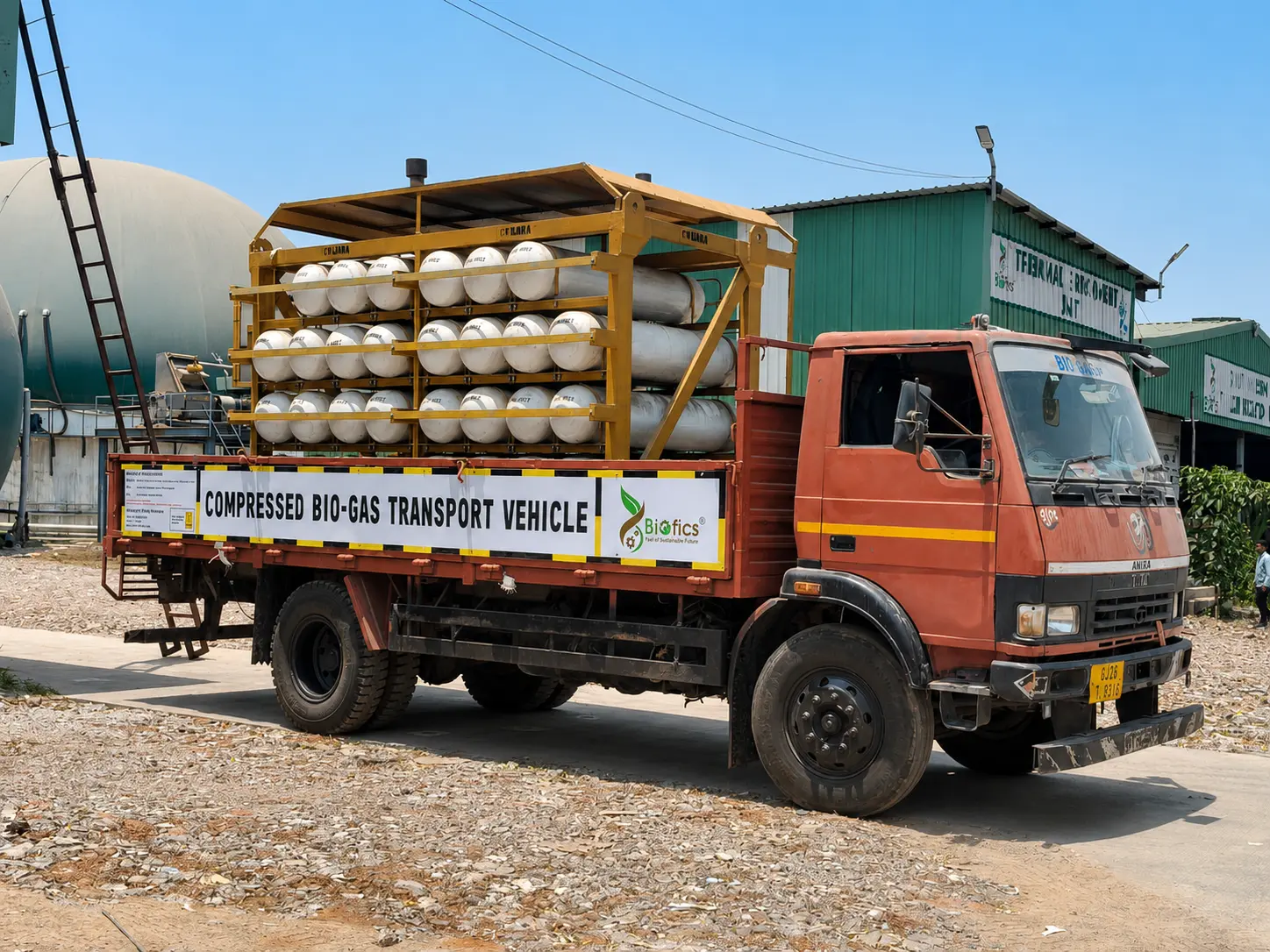
Pipeline injection can reduce recurring road movement where a technically and commercially suitable connection is available. Cascade transport may provide flexibility but adds compression, vehicle, handling and distance considerations. The correct model depends on the site and buyer—not merely on the national blending percentage.
5. Digestate and manure management
CBG production also generates digestate. Storage, dewatering, processing, quality control and a compliant use or sale plan should form part of the project design. Treating manure revenue as guaranteed can overstate viability.
Developers comparing capacity, land, feedstock, CAPEX drivers and project economics can also use Biofics’ detailed guide to CBG plant cost in India.
Step-by-Step Planning for a CBO-Aligned CBG Project
- Define the feedstock catchment: Map dependable quantities, seasonal availability, competing uses, collection systems and delivered cost.
- Characterise the feedstock: Test representative samples and estimate realistic biomethane potential under the proposed process conditions.
- Select capacity conservatively: Base rated output on secure daily feedstock and expected plant availability, with appropriate operational margins.
- Identify the relevant gas market: Confirm the CGD geographical area, authorised entity, eligible demand segments and procurement route.
- Compare evacuation options: Evaluate pipeline distance and connection scope against cascade compression, logistics and receiving arrangements.
- Obtain written commercial clarity: Review quantity, quality, price basis, tenure, delivery point, rejection, payment and commissioning conditions.
- Prepare the technical concept: Integrate reception, pre-treatment, digestion, upgrading, compression, utilities, safety and digestate management.
- Map approvals and schemes: Identify applicable registrations, environmental permissions, safety requirements and scheme eligibility without assuming approval.
- Build the financial model: Use project-specific CAPEX, OPEX, ramp-up, downtime and working-capital assumptions; run sensitivity cases.
- Proceed to DPR and execution: Finalise the project only after technical, commercial and regulatory risks have been assigned clearly.
Common Mistakes When Interpreting the CBG Mandate
- Applying 3% to all gas demand: The notified scope is CNG transport and PNG domestic consumption, not every gas-consuming segment.
- Assuming automatic plant allocation: A national obligation does not replace project-specific procurement and contracting.
- Ignoring the delivery point: A distant injection or receiving location can materially change logistics and cost.
- Designing from output backward: Declaring a target CBG capacity before validating feedstock can create an underutilised plant.
- Using only headline pricing: Revenue modelling must reflect the applicable contract, quality, energy basis, taxes, compression and transport responsibilities.
- Treating policy support as sanctioned funding: Announced assistance remains subject to eligibility, appraisal, guidelines and approval.
- Underestimating ramp-up and downtime: Commercial commitments should account for biological stabilisation and planned maintenance.
How Biofics Helps Plan and Execute CBG Projects
Biofics supports CBG projects from preliminary screening through engineering, manufacturing, installation, commissioning and operational support. The process begins with feedstock and site realities, followed by capacity selection, process design, gas upgrading and a practical dispatch or injection concept.
As a Bio-CNG plant manufacturer and turnkey EPC company, Biofics integrates feedstock reception, pre-treatment, anaerobic digestion, gas purification, compression and supporting systems around the project’s defined operating model. Commercial offtake, scheme eligibility and financial returns remain subject to the relevant authorities, buyers, contracts and project conditions.
Planning a CBG Project for the Growing Gas Market?
Share your proposed location, feedstock type, daily quantity, available land and intended offtake route with Biofics for a preliminary project discussion.
Frequently Asked Questions
What is the CBG Blending Obligation 2026?
The CBG Blending Obligation 2026 refers to the mandatory 3% CBG obligation for FY 2026–27, calculated against total CNG consumption in the transport segment and PNG consumption in the domestic segment. It forms part of a phased trajectory that rises to 4% in FY 2027–28 and 5% from FY 2028–29 onward.
Is CBG blending mandatory in India?
Yes, the notified programme became mandatory from FY 2025–26 after a voluntary phase through FY 2024–25. The first mandatory level was 1%, followed by 3% in FY 2026–27. Implementation is monitored through the designated framework and Central Repository Body.
Does the 3% CBG obligation apply to industrial PNG?
The original official announcement identifies CNG for transport and PNG for domestic households as the covered segments. Industrial and commercial PNG should not automatically be included in an obligation-based demand estimate unless a later applicable rule, procurement arrangement or contract specifically provides for it.
Will the CBG obligation guarantee the sale of gas from my plant?
No. It creates an aggregate demand signal, but a plant still needs a project-specific buyer and compliant delivery arrangement. Quantity, gas quality, price, connection, transport, metering, tenure and payment terms should be confirmed in the applicable procurement and contract documents.
What will the CBG blending target be after 2026–27?
The notified target is 4% for FY 2027–28 and 5% from FY 2028–29 onward. Developers should still verify whether any subsequent government notification or operational guideline has modified the implementation details before making an investment decision.
Can CBG be injected into a City Gas Distribution pipeline?
CBG may be supplied through a technically and commercially approved pipeline-injection arrangement where connectivity is available. The project must resolve gas quality, pressure, metering, injection location, pipeline scope, approvals and responsibility for connection costs with the relevant entities. Cascade delivery may be evaluated where direct connection is impractical.
How should a developer estimate demand created by the CBO?
Start with verified eligible CNG transport and domestic PNG consumption for the relevant market and apply the notified percentage for the financial year. Then validate measurement basis, procurement allocation, existing supply, network capacity and delivery conditions. The result is a screening estimate, not a confirmed plant offtake.
What information is needed before planning a CBG plant?
At minimum, define the feedstock type and secure daily quantity, seasonal availability, site and land, utilities, expected biomethane yield, intended capacity, relevant CGD area, buyer, delivery route, digestate plan and funding structure. These inputs are required before preparing a reliable feasibility study or DPR.
Conclusion
The CBG Blending Obligation 2026 raises the notified requirement to 3% for the CNG transport and domestic PNG segments, strengthening India’s long-term demand signal for compressed biogas. The opportunity is significant, but project success still depends on secure feedstock, reliable production, compliant gas, practical connectivity and written commercial arrangements. Investors should use the mandate as one input in a full technical and financial assessment—not as a substitute for one.