
To understand how to start a CBG plant in India, begin with feedstock and market feasibility—not machinery selection. A commercially dependable project requires verified feedstock, suitable land, realistic capacity, process engineering, statutory approvals, financing, gas offtake and a plan for managing digestate. These decisions must work together before construction begins.
The correct process normally starts with feedstock testing and a preliminary feasibility study, followed by capacity selection, site planning, a detailed project report, registration, approvals, financing, EPC execution and biological commissioning. Project cost, land requirement and output cannot be fixed from plant capacity alone because every feedstock and site behaves differently.
What Is a CBG Plant?
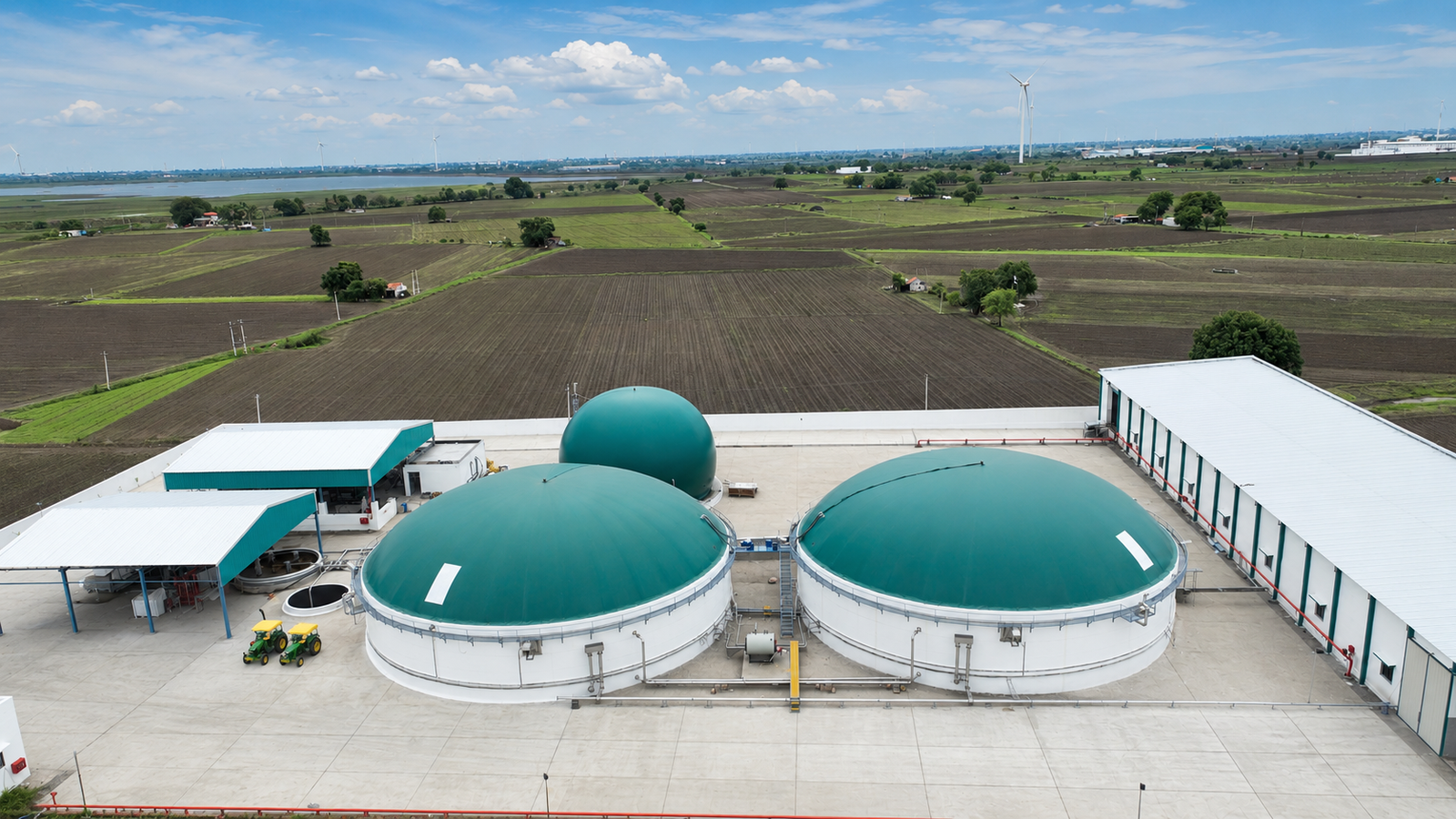
A Compressed Biogas or CBG plant converts biodegradable material into renewable gaseous fuel through anaerobic digestion. Common feedstocks include cattle dung, press mud, Napier grass, agricultural residue, segregated municipal organic waste, food waste and other biodegradable materials.
Anaerobic digestion initially produces raw biogas containing methane, carbon dioxide, moisture, hydrogen sulphide and other impurities. The gas is cleaned, upgraded and compressed to produce CBG of the required quality. The remaining digestate can be processed into solid or liquid organic manure, subject to applicable quality and regulatory requirements.
How to Start a CBG Plant in India: Complete Process
Starting a CBG plant involves a sequence of technical, commercial and regulatory decisions. Finalising plant capacity or placing a machinery order before validating feedstock, land and offtake can expose the project to underutilisation, redesign and additional investment.
- Identify and test the available feedstock.
- Estimate sustainable daily and seasonal availability.
- Select a realistic CBG production capacity.
- Evaluate the land, access, water and power availability.
- Prepare a feedstock mass balance and preliminary feasibility study.
- Identify the proposed gas offtake route.
- Prepare the DPR, plant layout and financial model.
- Complete registration and applicable statutory approvals.
- Arrange equity, debt and working capital.
- Complete detailed engineering, procurement and construction.
- Commission the plant and stabilise its biological process.
- Begin commercial operation with continuous performance monitoring.
Step 1: Assess Feedstock Before Selecting Plant Capacity
Feedstock is the foundation of CBG plant feasibility. The assessment must verify how much material is sustainably available, its seasonal variation, delivered cost, moisture, organic content, contamination level, methane potential and sourcing radius.
A laboratory or pilot-level assessment may examine total solids, volatile solids, carbon-to-nitrogen ratio, pH, fibre content, potential inhibitors and biochemical methane potential. The required tests depend on the proposed feedstock mix.
| Feedstock factor | Why it matters | What should be verified |
|---|---|---|
| Daily availability | Determines sustainable plant loading | Quantity available throughout the year |
| Seasonality | Affects annual capacity utilisation | Harvest, crushing or production calendar |
| Methane potential | Influences expected gas production | Representative laboratory testing |
| Moisture and solids | Changes pumping, mixing and digester design | Total and volatile solids |
| Contamination | Can damage equipment and reduce performance | Plastic, stones, sand, metal and grit |
| Delivered cost | Directly affects operating viability | Purchase, collection, storage and transport cost |
| Supply security | Protects the plant against interruptions | Ownership, agreements and alternative sources |
Feedstock requirement must not be estimated using one universal tonnes-per-TPD ratio. Two feedstocks with the same weight can produce materially different gas quantities because their moisture, organic content and methane potential differ.
Step 2: Select the Right CBG Plant Capacity
Plant capacity should be based on dependable feedstock availability and expected saleable gas—not on the maximum quantity claimed to be available during one season. The selected capacity should also consider process losses, maintenance, biological stability, feedstock storage and realistic annual operating days.
A developer comparing a 3 TPD, 5 TPD or 10 TPD project should prepare a mass balance for each option. This shows the required feedstock, water addition, raw biogas generation, CBG recovery, internal energy consumption and digestate output.
Illustrative Capacity Decision Framework
Assume a developer has access to cattle dung, Napier grass and agricultural residue. The following process should be used before selecting capacity:
- Record month-wise availability of each feedstock.
- Take representative samples for testing.
- Calculate conservative methane generation for the proposed mixture.
- Account for collection losses, storage losses and rejected material.
- Evaluate whether the minimum monthly supply can support the selected capacity.
- Maintain an alternative-feedstock strategy where technically compatible.
This framework is illustrative and is not a Biofics quotation, DPR, feedstock recommendation or production guarantee. Actual plant capacity must be supported by site-specific testing, process design and a detailed mass balance.
Step 3: Identify the Required Land and Site Infrastructure
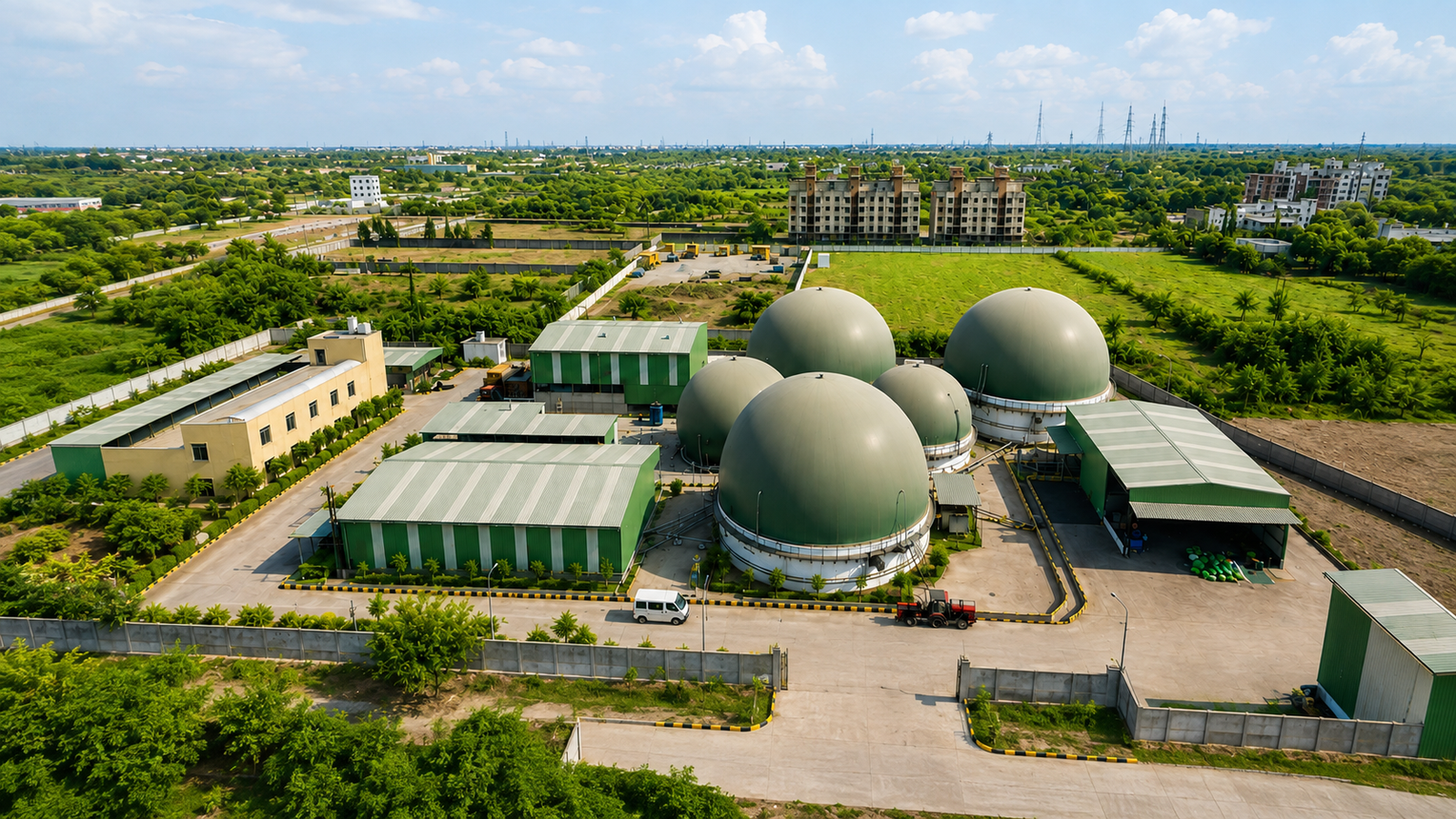
There is no universal land requirement for every CBG plant. Land depends on plant capacity, feedstock storage, digester configuration, internal roads, truck movement, gas storage, utilities, digestate processing, safety distances, greenbelt, drainage and future expansion.
The industrial plant area is different from the agricultural land that may be required to grow energy crops. Both should be evaluated separately during feasibility planning.
A suitable project site should normally be assessed for:
- Clear ownership or legally valid lease rights
- Permitted land use and conversion requirements
- Road access for feedstock and gas transportation
- Distance from feedstock sources
- Water source and water-related approvals
- Reliable grid connection and backup power
- Flood level, soil condition and natural drainage
- Distance from habitation and environmentally sensitive areas
- Pipeline, CGD station or cascade delivery accessibility
- Space for manure storage and dispatch
Step 4: Understand the Main CBG Plant Components
A CBG plant is an integrated process rather than a single machine. Equipment must be selected according to feedstock behaviour, required retention time, gas quality, redundancy and the proposed delivery route.
| Plant section | Typical purpose | Main design consideration |
|---|---|---|
| Feedstock reception | Weighing, unloading and storage | Daily volume and contamination |
| Preprocessing | Segregation, shredding, crushing or mixing | Feedstock size and consistency |
| Feeding system | Controlled transfer to the digestion process | Solids content and pumpability |
| Anaerobic digesters | Biological conversion into raw biogas | Loading rate, mixing and retention time |
| Gas cleaning | Removal of moisture and hydrogen sulphide | Raw-gas composition |
| Gas upgrading | Separation of carbon dioxide and impurities | Product quality and methane recovery |
| Compression and storage | Preparation of CBG for dispatch or injection | Delivery pressure and evacuation route |
| Digestate processing | Separation, storage and manure preparation | Moisture, market and compliance |
| Electrical and automation | Controls, monitoring and plant safety | Load, redundancy and operating visibility |
Biofics explains this connected conversion process on its Bio-CNG plant and turnkey EPC solutions page.
Step 5: Decide How the CBG Will Be Sold
The gas offtake route should be evaluated before freezing the site and compression system. CBG may be supplied through cascades, injected into an authorised gas network where technically and commercially approved, or sold through another permitted arrangement.
Developers should discuss gas quantity, quality, delivery pressure, metering, transportation, delivery point, price mechanism and payment conditions with the proposed buyer. A letter of intent or preliminary discussion should not automatically be treated as final commercial closure.
India’s CBG demand framework is also supported by the phased CBG Blending Obligation. The applicable target is 3% for FY 2026–27, increasing to 4% in FY 2027–28 and 5% from FY 2028–29. The practical implications are explained in Biofics’ guide to the CBG Blending Obligation 2026.
Step 6: Estimate CBG Plant Cost and Financial Viability
CBG plant cost includes much more than digester and purification machinery. A complete financial assessment should include land development, civil work, feedstock infrastructure, process equipment, gas upgrading, compression, electrical systems, utilities, laboratory, approvals, engineering, project management, finance costs and working capital.
The financial model should test:
- Delivered feedstock cost
- Expected methane yield and recovery
- Annual capacity utilisation
- Plant electricity and water consumption
- Labour, maintenance and consumables
- Gas sale price and transportation cost
- Digestate processing and realistic manure realisation
- Interest, repayment and working-capital requirements
- Ramp-up time before stable commercial operation
For a detailed explanation of CAPEX and project cost drivers, refer to the Biofics guide on CBG plant cost in India.
Step 7: Prepare the DPR and Project Documents
A Detailed Project Report converts preliminary assumptions into a technically and financially reviewable project. It is commonly required for internal approval, bank appraisal, investor evaluation, subsidy applications and coordination with authorities.
A project-specific DPR may cover:
- Promoter and project background
- Feedstock study and supply strategy
- Laboratory results and process assumptions
- Capacity and mass-balance calculations
- Technology selection and process flow
- Land details and proposed plant layout
- Utility and manpower requirements
- Implementation schedule
- CAPEX, OPEX and working-capital estimates
- Gas and manure marketing plan
- Risk analysis and mitigation strategy
- Applicable approvals and compliance plan
Step 8: Complete Registrations and Statutory Approvals
The exact approval list varies according to the state, land status, feedstock, storage system, gas evacuation route and project configuration. Developers should create an approval matrix with responsibility, required documents and target dates.
Anyone operating or intending to establish a CBG/Bio-CNG plant can obtain a registration number through the official GOBARdhan Unified Registration Portal. Government information states that this registration number is required for accessing support from relevant ministries and departments.
Depending on the project, the approval process may involve:
- Company, tax and project-entity registrations
- Land ownership, lease and land-use permissions
- GOBARdhan registration
- Consent to Establish and Consent to Operate, where applicable
- Factory, labour and local-body permissions
- Fire and emergency-safety approvals
- Electricity connection and electrical inspection
- Water withdrawal or groundwater permissions, where applicable
- PESO-related approvals for applicable compression and storage facilities
- Gas quality, metering and buyer-specific compliance
- Fertilizer-related compliance for marketing digestate products
This is a general planning list, not a universal statutory checklist. The required permissions must be confirmed with the relevant central, state and local authorities for the specific site and project design.
Step 9: Check Current CBG Subsidy and Policy Support
On 6 August 2026, the Union Cabinet approved the national GOBARdhan scheme for CBG with a stated outlay of ₹23,731 crore. The official announcement includes capital assistance of up to ₹2 crore per TPD for eligible greenfield projects, along with other ecosystem support.
The words “up to” are important. A headline assistance amount must not be treated as automatic approval, assured cash flow or a substitute for project viability. Eligibility conditions, final operational guidelines, appraisal, sanctioned amount, milestone compliance and fund availability must be checked.
The official scheme announcement can be reviewed through the Prime Minister of India’s GOBARdhan scheme release. Biofics has also prepared a practical guide covering CBG plant subsidy eligibility and application planning.
Step 10: Execute, Commission and Stabilise the Plant
After financial closure and approvals, the project moves through detailed engineering, procurement, civil construction, fabrication, installation and pre-commissioning checks. Equipment completion alone does not mean that a biological CBG plant is ready for full production.
- Freeze the process design and approved plant layout.
- Complete civil, mechanical, electrical and instrumentation engineering.
- Procure and manufacture equipment according to the approved specifications.
- Execute civil works with quality and dimensional checks.
- Install process, gas, electrical and safety systems.
- Perform dry and wet commissioning checks.
- Inoculate the digestion system and begin controlled feeding.
- Increase biological loading gradually while monitoring process health.
- Commission gas cleaning, upgrading and compression systems.
- Verify product-gas quality, metering and safety interlocks.
- Train operators and complete performance monitoring.
- Begin commercial dispatch after required approvals and acceptance.
Common Mistakes While Starting a CBG Plant
- Selecting capacity before testing feedstock
- Depending on verbal feedstock availability claims
- Ignoring seasonal supply and storage requirements
- Comparing quotations with different scope boundaries
- Purchasing isolated equipment without integrated process responsibility
- Finalising land before checking approvals and logistics
- Treating subsidy as assured project equity
- Assuming manure revenue without a market and compliance plan
- Freezing compression equipment before confirming the offtake route
- Underestimating working capital and biological ramp-up time
- Rushing commissioning to reach full loading prematurely
- Operating without trained biological and mechanical personnel
How Biofics Helps in Setting Up a CBG Plant
Biofics provides integrated Bio-CBG project support covering feedstock-led planning, process engineering, plant manufacturing, installation, commissioning and operational assistance. The objective is to connect digestion biology, mechanical equipment, gas upgrading and site execution within one coordinated project approach.
Depending on the agreed scope, a project engagement may include feedstock assessment, feasibility inputs, engineering, equipment integration, civil coordination, automation, gas purification, commissioning and operator training. Final scope, capacity, output and commercial terms must be established through a project-specific proposal.
Planning to Start a CBG Plant in India?
Share your proposed feedstock, daily availability, land location and expected CBG capacity with Biofics for a preliminary project discussion.
Frequently Asked Questions
How do I start a CBG plant in India?
To start a CBG plant in India, first verify feedstock availability and methane potential. Then assess the land, select a realistic capacity, identify the gas buyer, prepare a feasibility study and DPR, complete registrations and approvals, arrange finance, appoint an experienced EPC partner and execute controlled biological commissioning.
How much land is required for a CBG plant?
There is no fixed land requirement applicable to every project. It depends on plant capacity, feedstock storage, digesters, vehicle movement, utilities, gas storage, digestate management, safety distances and expansion. Energy-crop cultivation land should be calculated separately from the industrial plant site.
How much feedstock is required for a 5 TPD CBG plant?
The required feedstock cannot be calculated from the 5 TPD capacity alone. It depends on feedstock type, moisture, volatile solids, methane potential, contamination, process recovery and storage losses. A representative feedstock test and mass balance are required before finalising the daily quantity.
What is the cost of starting a CBG plant in India?
CBG project cost is site- and feedstock-specific. It includes land development, civil works, feedstock systems, digesters, purification, compression, utilities, electrical systems, approvals, engineering, working capital and financing costs. A complete feasibility study is required instead of relying on a universal per-TPD price.
Is a government subsidy available for a CBG plant?
Government support may be available to eligible projects under current central or state programmes. The national GOBARdhan scheme announced in August 2026 states capital assistance of up to ₹2 crore per TPD for eligible greenfield projects. Actual eligibility and sanction depend on applicable operational guidelines and appraisal.
Which feedstock is best for a CBG plant?
No single feedstock is best for every project. Selection depends on availability, methane potential, delivered cost, moisture, storage behaviour, preprocessing needs and process compatibility. Cattle dung, press mud, Napier grass, agricultural residue and segregated organic waste can all be considered after appropriate testing.
Which approvals are required for a CBG plant?
Approvals vary by state and project design. They may include land-use permission, GOBARdhan registration, pollution-control consent, fire approval, factory registration, electricity approval, water permission, PESO-related approvals and buyer-specific gas compliance. A site-specific statutory matrix should be prepared.
How long does it take to set up a CBG plant?
The timeline depends on land readiness, approvals, financial closure, engineering, equipment manufacturing, civil construction, installation and biological stabilisation. A generic completion promise is unreliable without reviewing the capacity, site conditions, technology, procurement scope and approval status.
Can a CBG plant be profitable in India?
A CBG plant can be commercially viable when delivered feedstock cost, methane yield, uptime, gas realisation, logistics, financing and digestate management work together. Profit, ROI and payback should be calculated through a project-specific financial model and stress-tested without depending entirely on subsidy.
Conclusion
Understanding how to start a CBG plant in India begins with feedstock security, testing and project feasibility. Capacity, land, technology, investment, approvals and gas offtake should then be developed as one connected plan. Before purchasing machinery or committing capital, prepare a defensible mass balance, DPR, approval matrix and implementation strategy for the proposed site.