
CBG plant cost in India cannot be reduced to one machinery quote. A commercially ready project must budget for land development, civil works, feedstock handling, digesters, gas purification, compression, utilities, statutory compliance, evacuation, digestate management and working capital. This 2026 guide explains the investment logic, practical cost drivers and viability checks for Indian projects.
Bio-CNG is the commonly used market term for purified and compressed biogas. Raw biogas contains methane, carbon dioxide, moisture and impurities; CBG is produced after purification and compression to the applicable quality specification.
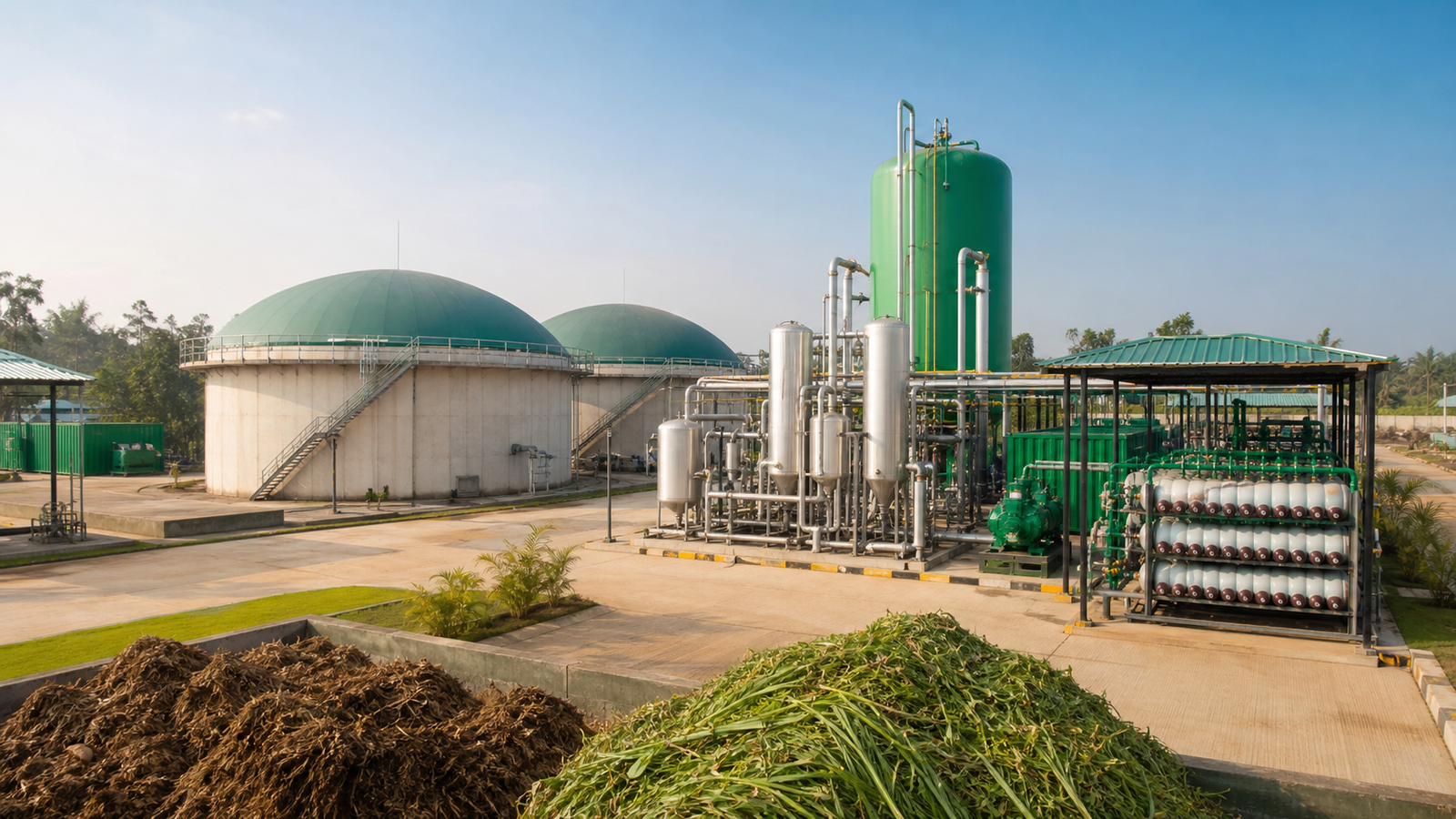
What Is the Average CBG Plant Cost in India?
A commercial CBG plant in India does not have a reliable universal “₹ per TPD” price. For preliminary planning, investors should develop a project-specific budget based on feedstock, capacity, site, civil scope, purification technology, gas evacuation, utilities and working capital. A 5 TPD proposal can vary materially even when two vendors quote the same output capacity.
Important: Any financial range or percentage in this article is indicative only. It is not a commercial quotation, DPR or financial commitment from Biofics.
CBG Plant Cost in India: What the Total Investment Includes
| Project head | What it normally covers | Main cost driver |
|---|---|---|
| Land and development | Survey, grading, drainage, roads, boundary and greenbelt | Location, soil and site condition |
| Feedstock system | Collection, weighing, storage, shredding, pulping and contaminants removal | Feedstock type and sourcing radius |
| Digestion | Digesters, mixing, heating, pumps, piping and gas holders | Retention time and process configuration |
| Gas upgrading | H₂S removal, drying, CO₂ removal and gas analysis | Raw-gas quality and recovery target |
| Compression and evacuation | Compressor, storage, cascades or pipeline interface | Offtake route and distance |
| Utilities and automation | Electricals, water, fire safety, PLC/SCADA and laboratory | Grid availability and redundancy |
| Digestate management | Solid-liquid separation, manure drying, storage and packing | Product route and local market |
| Pre-operative and working capital | Approvals, engineering, insurance, ramp-up inventory and operating cash | Financing and stabilisation period |
The CBG plant machinery cost therefore represents only one part of the complete CBG project cost. GST, freight, finance costs and exclusions also need to be compared on the same basis.
5 TPD CBG Plant Cost: A Practical Planning Framework
For a 5 TPD CBG plant, use percentage allocation before seeking a detailed quotation. The following is an illustrative budgeting framework—not a benchmark price.
| Project head | Illustrative share | Main variables |
|---|---|---|
| Land development and civil works | 18–25% | Owned/leased land, foundations, roads and storage |
| Feedstock handling and preprocessing | 8–15% | Harvesting, segregation, silage and contamination |
| Digesters and biogas system | 25–35% | Feedstock, loading rate, retention time and redundancy |
| Purification, compression and storage | 15–22% | Technology, gas quality, cascade or pipeline |
| Utilities, electricals and automation | 7–12% | Power connection, water, SCADA and laboratory |
| Manure system, engineering and contingency | 8–15% | Dewatering, packaging, approvals and scope gaps |
This example is intended for preliminary understanding only and should not be treated as a commercial quotation, DPR or financial commitment from Biofics.
Cost changes when civil work is excluded, land is already owned, harvesting equipment is included, multiple digesters are selected, cascade transport replaces pipeline injection, manure processing is added or an O&M partner operates the plant.
How Much Land Is Required for a CBG Plant?
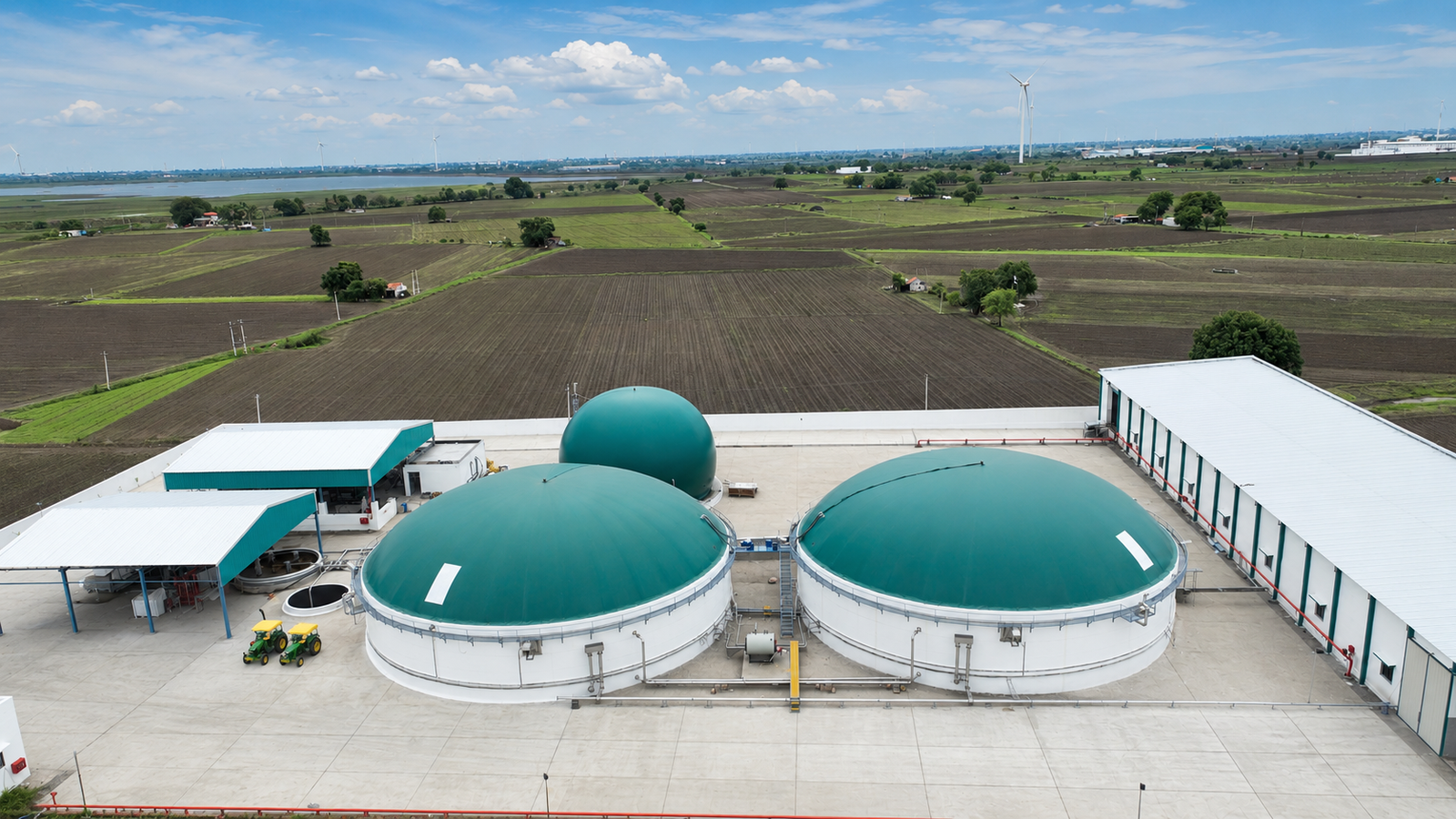
The CBG plant land requirement depends on capacity, feedstock storage, digester layout, vehicle movement, setbacks, manure storage, utilities, greenbelt and expansion. A 5 TPD industrial site often needs several acres, but a defensible number can be produced only after a layout and local approval review.
Plant-site land must not be confused with farmland used to cultivate Napier grass or another energy crop. Cultivation acreage depends on crop yield, harvest cycles, irrigation, silage losses and the proportion of other feedstocks in the recipe.
Feedstock Requirement for a CBG Plant
There is no universal feedstock-tonnage-to-CBG conversion. Saleable output depends on total solids, volatile solids, methane potential, moisture, contamination, digestibility, retention time, process efficiency and methane recovery. This is why laboratory testing and seasonal sampling should precede capacity selection.
| Feedstock | Important characteristic | Cost impact | Operational challenge |
|---|---|---|---|
| Cattle dung | High moisture; relatively stable | Collection and transport | Dispersed supply and low solids |
| Napier grass | Planned energy crop | Cultivation, harvesting and silage | Seasonal planning and preprocessing |
| Press mud | Sugar-sector residue | Procurement and storage | Seasonality and long-term preservation |
| Food waste | Often higher gas potential | Segregation and collection | Variable composition |
| Municipal organic waste | Urban availability | Sorting and contaminant removal | Inerts and inconsistency |
| Agricultural residue | Large resource potential | Aggregation and preprocessing | Lignocellulosic structure |
No feedstock is universally “best”. Secure year-round supply, delivered cost and stable methane yield are often more important than the lowest initial EPC price.
CBG Plant Operating Cost
| Cost type | Typical items |
|---|---|
| Fixed operating cost | Core manpower, insurance, administration, laboratory and scheduled contracts |
| Variable operating cost | Feedstock, transport, power, water, chemicals, spares, purification media, manure handling and cascade logistics |
| Financing-related outflow | Interest, principal repayment, DSRA requirements and lender fees |
Low plant uptime raises the effective cost per kilogram because salaries, finance and many maintenance costs continue while saleable CBG falls. Working capital should cover feedstock inventory, salaries, utilities, consumables, logistics and the biological ramp-up period.
Revenue Sources and CBG Plant Profitability
Primary revenue normally comes from sale of CBG to an OMC/CGD buyer, an industrial user or a pipeline network where technically and commercially feasible. Secondary revenue may come from fermented organic manure, liquid manure, eligible tipping fees or verified environmental attributes. Carbon credits and manure realisation must not be treated as guaranteed.
Annual CBG Revenue = Daily Saleable CBG × Operating Days × Realised CBG Price
Annual Project Revenue = CBG Revenue + Manure Revenue + Eligible Service Revenue
Operating Surplus = Total Revenue − Feedstock − Utilities − Manpower − Maintenance − Logistics − Other OPEX
Operating surplus is not net profit: depreciation, interest, tax and financing obligations still apply. A CBG plant can be profitable in India when feedstock cost, methane yield, utilisation, uptime, sale price, logistics and debt structure work together. There is no responsible universal promise for CBG plant profit per day, ROI or payback.
CBG Plant Subsidy in India in 2026
On 6 August 2026, the Union Cabinet approved the unified GOBARdhan National Circular Bioenergy Scheme. The official announcement states capital assistance of up to ₹2 crore per TPD for eligible greenfield CBG projects, a ₹2,110/MMBTU administered pricing framework and support for pipeline infrastructure and eligible MSME credit. “Up to” is not the same as an automatic sanction: eligibility, operational guidelines, registration, appraisal and actual approval matter.
Read Biofics’ detailed guide to the GOBARdhan Scheme 2026 and CBG capital assistance. Also verify current application windows on the GOBARdhan portal and applicable programme guidance on the MNRE Waste-to-Energy page.
Approvals Required to Establish a CBG Plant
Requirements vary by state, site, capacity, technology and offtake route. A project may require land and company documents, GOBARdhan registration, Consent to Establish/Operate, fire and factory approvals, electrical and water permissions, local building approval, gas compression/storage compliance, pipeline or road-crossing permissions, manure-product compliance and OMC/CGD documentation. Treat this as a planning list, not an exhaustive legal checklist.
How Long Does It Take to Establish a CBG Plant?
A commercial project commonly moves through feasibility, feedstock assessment, land finalisation, DPR, financial closure, offtake planning, approvals, engineering, civil work, manufacturing, installation, commissioning and biological stabilisation. Depending on readiness and scope, planning-to-ramp-up may take roughly 12–24 months. Land issues, approvals, financing, feedstock contracts, imported components and utility connectivity often cause delay.
How to Start a CBG Plant in India
- Map sustainable feedstock and delivered cost.
- Test representative seasonal samples.
- Estimate realistic annual availability and storage losses.
- Select capacity from feedstock—not the other way around.
- Finalise land, water, power and logistics.
- Select digestion and preprocessing technology.
- Confirm the gas offtake and evacuation route.
- Define the complete EPC boundary.
- Prepare CAPEX, OPEX and conservative revenue cases.
- Assess subsidy eligibility and perform sensitivity analysis.
- Prepare the DPR, obtain finance and proceed to detailed engineering.
Common Costing Mistakes
- Comparing only machinery price: it hides civil, utility and evacuation costs.
- Assuming identical gas yield: moisture, contamination and biodegradability vary.
- Ignoring transport: delivered feedstock cost can change the business case.
- Underestimating working capital: ramp-up expenses arrive before stable revenue.
- Assuming subsidy is guaranteed: assistance remains conditional on eligibility and sanction.
- Overestimating manure revenue: quality, moisture, compliance and distribution determine realisation.
- Ignoring seasonal storage: press mud and crops need preservation and space.
- Excluding evacuation: cascades, pipeline interface and road logistics are material.
- Under-budgeting O&M: purification media, compressor service and spares affect uptime.
- Choosing the lowest quote: exclusions and lifecycle performance may make it costlier.
Why EPC Scope Matters
| Check | Confirm in every quotation |
|---|---|
| Civil and feedstock equipment | Included boundary, storage and preprocessing |
| Digester and gas system | Design basis, redundancy and performance responsibility |
| Purification and compression | Gas specification, recovery, storage and evacuation |
| Electricals and automation | Transformer, backup power, PLC/SCADA and instrumentation |
| Manure management | Separation, drying, storage, packing and quality route |
| Execution support | Installation, commissioning, testing, training and O&M |
| Commercial exclusions | Taxes, freight, approvals, consumables and warranties |
How Biofics Supports CBG Project Development
Biofics supports industrial waste-to-energy and Bio-CNG projects through preliminary assessment, feedstock and capacity evaluation, feasibility studies, DPR preparation, process design, layout and engineering, equipment planning and manufacturing, procurement coordination, installation, gas purification and compression, commissioning, training and operational support.
Explore Biofics’ Bio-CNG plant solutions, understand the biogas plant process or request a preliminary project assessment.
Planning to Set Up a CBG Plant?
Before fixing capacity or investment, assess your feedstock, site conditions, land, gas offtake route and complete EPC scope.
Frequently Asked Questions
How much does a CBG plant cost in India?
The CBG plant cost in India is project-specific. It depends on feedstock, capacity, land, civil works, digester design, purification, compression, evacuation, utilities and working capital. Compare complete EPC boundaries instead of using a single machinery-price number.
What is the cost of a 5 TPD CBG plant?
A fixed online number is not a dependable quotation. A 5 TPD plant requires a feedstock study, site layout, technology selection and offtake plan before CAPEX and OPEX can be estimated.
How much land is required for a 5 TPD CBG plant?
Several acres may be needed depending on storage, digesters, vehicle movement, manure handling, greenbelt and setbacks. Cultivation land for an energy crop is separate from the industrial plant site.
How much feedstock is needed for 5 TPD CBG?
It cannot be calculated from capacity alone. Required tonnage depends on solids, methane potential, moisture, contamination, retention time and process recovery. Laboratory tests and a mass-balance are essential.
Is a CBG plant profitable in India?
It can be commercially viable, but profitability depends on delivered feedstock cost, methane yield, uptime, realised gas price, logistics, financing and manure realisation.
What subsidy is available in 2026?
The August 2026 GOBARdhan announcement provides capital assistance of up to ₹2 crore per TPD for eligible greenfield projects. Actual support depends on final guidelines, eligibility, appraisal and sanction.
What is the government CBG price?
The August 2026 Cabinet announcement introduced an administered framework of ₹2,110/MMBTU. Project revenue should use the applicable contract terms, quality, taxes, delivery point and current operational guidelines.
Which feedstock is best?
No feedstock is universally best. Choose using year-round availability, delivered cost, methane yield, contamination, storage and compatibility with the selected process.
What are the major operating expenses?
Feedstock, transport, electricity, water, labour, consumables, purification media, compressor maintenance, spares, laboratory testing, manure handling, insurance and gas evacuation.
How long does a plant take?
A realistic indicative planning-to-ramp-up period is about 12–24 months, depending on land, approvals, finance, engineering, construction, supply chain and biological stabilisation.
Which approvals are required?
Typical requirements include pollution-control consents, fire, factory, electrical, water, local building, gas storage/compression, manure and offtake-related compliance. State and project conditions determine the final list.
How can Biofics help?
Biofics can support assessment, DPR, process and layout engineering, equipment planning, EPC coordination, purification, compression, commissioning, training and operational support.
Conclusion
CBG plant cost in India cannot be determined through a single per-TPD machinery price. Feedstock, capacity, land, technology, civil scope, purification, evacuation, utilities, manure management, working capital and operating strategy all shape viability. Begin with a feedstock and site feasibility assessment before finalising capacity, finance or an EPC partner.