
The GOBARdhan Scheme 2026 for CBG is India’s new unified support framework for Compressed Biogas projects. Approved by the Union Cabinet on 6 August 2026 with a total outlay of ₹23,731 crore, the scheme brings assured offtake, long-term administered pricing, capital assistance, pipeline connectivity, credit guarantees and ecosystem development under one national programme.
For eligible projects, the government has announced capital assistance of up to ₹2 crore per tonne per day (TPD) of installed CBG capacity. The scheme also introduces an administered CBG price of ₹2,110 per Metric Million British Thermal Unit (MMBTU), stated by the government as equivalent to ₹105 per kilogram. This guide explains the subsidy framework, eligibility, registration, practical project requirements and the decisions investors must validate before committing capital.
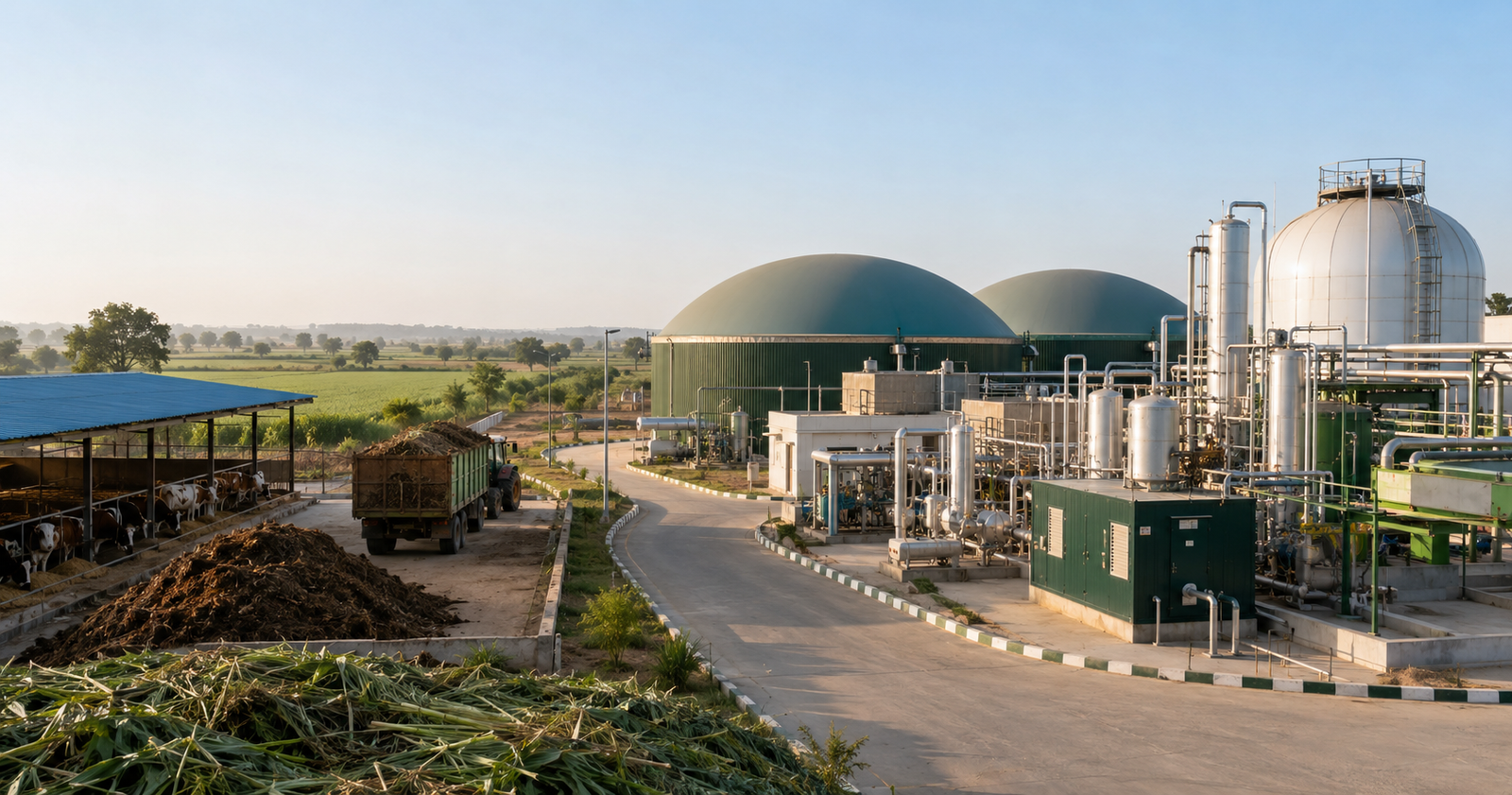
What Is the GOBARdhan Scheme 2026 for CBG?
GOBARdhan stands for Galvanizing Organic Bio-Agro Resources Dhan. It was originally launched in 2018 under the Swachh Bharat Mission (Grameen) to convert biodegradable waste into biogas and bio-slurry. The 2026 National Circular Bioenergy Scheme expands that approach into an integrated framework for scaling commercial CBG production.
According to the official PIB GOBARdhan backgrounder, the scheme will operate from FY 2026–27 to FY 2035–36 under the Ministry of Petroleum and Natural Gas. Its stated objective is to increase domestic CBG production nearly ten-fold while strengthening investment, rural income, waste management and energy security.
GOBARdhan Scheme 2026: Key Details
| Provision | Announced framework | Why it matters |
|---|---|---|
| Total outlay | ₹23,731 crore | Ten-year national support for the CBG value chain |
| Implementation period | FY 2026–27 to FY 2035–36 | Provides a long-term policy horizon |
| Capital assistance | Up to ₹2 crore per TPD for eligible CBG capacity | Can reduce the initial capital burden |
| Administered CBG price | ₹2,110/MMBTU, stated as ₹105/kg | Improves revenue visibility |
| Credit guarantee | Up to 85% on eligible MSME project loans | May improve access to institutional finance |
| CBG obligation | 3%, 4%, then 5% from FY 2028–29 | Creates a defined demand signal |
| Pipeline support | Cluster-based and standalone connectivity | Can connect plants with CGD and trunk networks |
Important qualification: “Up to” is not the same as an automatic entitlement. Project eligibility, approved expenditure, assistance limits, documentation and disbursement will depend on the final operational guidelines and appraisal by the competent authority.
What Are the Six Components of the GOBARdhan Scheme?
1. Assured CBG Offtake
The scheme establishes a CBG Offtake Assurance Framework. Procurement by City Gas Distribution (CGD) entities is intended to support the notified CBG obligation of 3% in FY 2026–27, 4% in FY 2027–28 and 5% from FY 2028–29 onwards in the CNG transport and domestic PNG segments.
This creates a stronger demand signal, but a project developer must still confirm the actual buyer, delivery point, gas-quality requirements, metering, compression, cascade logistics or pipeline-injection arrangement for the proposed site.
2. Stable CBG Pricing
The announced administered price is ₹2,110/MMBTU, which the government states is equivalent to ₹105/kg of CBG. The framework has a minimum ten-year horizon. This can improve financial modelling, although revenue assumptions should still account for contracted quantity, gas acceptance, downtime, logistics and applicable commercial terms.
3. Capital Assistance
Eligible greenfield CBG projects can receive capital assistance of up to ₹2 crore per TPD of installed CBG capacity. The official announcement also states that eligible brownfield projects expanding production capacity may qualify. Support can extend beyond core machinery to critical assets for feedstock aggregation, organic-manure processing and value addition.
4. Pipeline Infrastructure
The framework supports standalone and cluster-based pipelines connecting CBG plants with City Gas Distribution networks and trunk pipelines. Pipeline injection can reduce dependence on cascade movement, but route feasibility, right of way, injection specifications, connectivity cost and approval from the relevant network operator must be assessed separately.
5. Credit Guarantee Support
A dedicated mechanism will provide credit-guarantee coverage of up to 85% on eligible loans for qualifying MSME-based CBG projects. This may reduce lender risk and collateral pressure, but it does not replace normal appraisal of promoter capability, feedstock security, technology, approvals, offtake and repayment capacity.
6. CBG Ecosystem Challenge Fund
This component is intended to support district-level feedstock mapping, aggregation infrastructure, local CBG planning, technology adoption, process improvement, organic-manure value addition and stakeholder capacity building. It recognises that a CBG plant cannot operate reliably without an ecosystem around it.
How Much CBG Capital Assistance Could a Project Receive?
The announced ceiling is calculated against eligible installed CBG capacity. The table below is an illustrative mathematical calculation, not a sanction estimate or Biofics quotation.
| Installed CBG capacity | Calculation at ₹2 crore/TPD | Indicative maximum |
|---|---|---|
| 3 TPD | 3 × ₹2 crore | Up to ₹6 crore |
| 5 TPD | 5 × ₹2 crore | Up to ₹10 crore |
| 10 TPD | 10 × ₹2 crore | Up to ₹20 crore |
Actual assistance may be lower than the arithmetic ceiling. A developer should not reduce the financing requirement or assume subsidy receipt until eligibility, eligible project cost, sanction conditions and the disbursement mechanism are formally confirmed.
Who May Be Eligible for the CBG Subsidy?
The official announcement identifies eligible greenfield CBG projects and brownfield projects that expand CBG production capacity. A complete eligibility test will depend on the detailed operational guidelines. Until those are verified, developers should treat the following as a project-readiness checklist rather than a final statutory list:
- Legally established applicant entity with complete KYC and ownership information
- Suitable land with clear ownership or enforceable long-term lease rights
- Defined installed CBG capacity supported by a credible mass and energy balance
- Year-round feedstock assessment covering quantity, quality, seasonality and delivered cost
- Appropriate process technology for the selected feedstock
- Proposed gas offtake, cascade dispatch or pipeline-injection route
- Required pollution-control, safety, water, fire and other project approvals
- Detailed Project Report, financing plan and implementation schedule
- GOBARdhan registration and any additional programme-specific registration
The government’s GOBARdhan Unified Registration Portal directs commercial CBG applicants to the dedicated CBG registration system. PIB states that a registration number is required to access eligible MoPNG benefits and support.
Is the GOBARdhan Subsidy Application Open?
The Cabinet approval and PIB backgrounder establish the scheme framework, but developers should verify the latest operational notification, application window, competent implementing agency and portal instructions before filing or relying on the assistance in a financial model.
Registration of a proposed CBG project and submission of a capital-assistance claim are not necessarily the same step. A registration number records the project within the ecosystem; sanction of financial assistance may require a separate application, appraisal, eligible-cost verification and milestone-based compliance.
What Must Be Planned Before Developing a CBG Project?
Feedstock Security
Feedstock must be assessed on usable organic content, methane potential, contamination, moisture, seasonality, collection radius and delivered cost. A nominal daily tonnage is not sufficient. Representative testing and supply-chain planning are essential before finalising plant capacity.
Land and Logistics
Land needs depend on feedstock reception, storage, pre-treatment, digesters, gas upgrading, compression, utilities, manure processing, roads, safety distances and future expansion. The site must also support heavy-vehicle access and reliable feedstock movement.
Utilities and Process Integration
Power, water, drainage, process heating, laboratory facilities, fire protection and backup systems must be designed together. The Biofics Bio-CNG plant engineering approach begins with actual feedstock and operating conditions before equipment selection.
Gas Offtake and Evacuation
A project must define whether CBG will be moved through cascades, dispensed, used captive or injected into a gas network. The commercial model changes with distance to the buyer, compression and transport cost, injection infrastructure and accepted gas quantity.
Organic Manure Management
Digestate is not automatically a saleable product. Dewatering, quality control, storage, value addition, compliance, farmer acceptance and distribution arrangements should be planned as carefully as gas sales.
GOBARdhan Scheme 2026 vs Earlier CBG Support
GOBARdhan does not erase the work already done through SATAT, Market Development Assistance, Biomass Aggregation Machinery support, pipeline infrastructure and the National Bioenergy Programme. Its key change is to consolidate major CBG interventions under a unified MoPNG-led framework.
| Area | Earlier support landscape | GOBARdhan 2026 direction |
|---|---|---|
| Administration | Support distributed across programmes and ministries | Unified framework led by MoPNG |
| Offtake | SATAT and market-development mechanisms | Dedicated assurance linked with CBG obligation |
| Pricing | Separate procurement arrangements | Administered price with a minimum ten-year horizon |
| Capital support | Separate financial-assistance programmes | Up to ₹2 crore/TPD for eligible capacity |
| Finance | Conventional lender assessment | Dedicated guarantee for eligible MSME loans |
| Local ecosystem | Individual feedstock and project initiatives | Challenge Fund for district-level development |
The official SATAT portal remains a useful reference for the earlier CBG market-development framework. Project developers should confirm how existing letters, contracts, registrations and benefits interact with the new operational guidelines.
Step-by-Step Readiness Process for a GOBARdhan CBG Project
- Screen the opportunity: Define the applicant, proposed location, feedstock, target capacity and intended gas buyer.
- Validate feedstock: Test representative material and model year-round availability, storage, collection and transport.
- Assess the site: Confirm land title or lease, access, utilities, drainage, safety constraints and nearby gas infrastructure.
- Prepare the project concept: Develop the process basis, mass balance, preliminary layout, output estimate and manure strategy.
- Confirm offtake: Engage the relevant OMC, CGD entity, gas-network operator or captive buyer.
- Build a financial model: Use qualified assumptions for CAPEX, OPEX, ramp-up, downtime, feedstock, logistics, gas and manure revenue.
- Register the project: Obtain the applicable GOBARdhan registration and retain all acknowledgement records.
- Review scheme guidelines: Match the project with notified eligibility, eligible costs, financing conditions and application milestones.
- Complete approvals and financing: Coordinate statutory permissions, lender appraisal and documentation.
- Proceed to detailed engineering: Finalise technology, equipment, civil interfaces, construction, commissioning and operations planning.
Common Mistakes to Avoid
- Treating “up to ₹2 crore per TPD” as an automatic sanctioned amount
- Selecting plant capacity from available land or desired output without feedstock testing
- Assuming GOBARdhan registration alone constitutes subsidy approval
- Using ₹105/kg as guaranteed realised revenue without reviewing contract and delivery terms
- Ignoring seasonal feedstock storage and delivered logistics cost
- Planning pipeline injection without route, network and technical feasibility
- Considering digestate revenue without a compliant processing and marketing plan
- Choosing technology before defining feedstock characteristics and operating regime
- Starting procurement before completing approvals, financing and project interfaces
How Biofics Supports CBG Project Development
Biofics Private Limited supports commercial CBG projects from early-stage assessment through engineering and execution. The objective is to establish whether a proposed opportunity is technically and commercially credible before major investment decisions are made.
Support can include preliminary feasibility, feedstock and capacity assessment, Detailed Project Report preparation, process engineering, plant layout, equipment planning, manufacturing, installation coordination, gas upgrading, commissioning and operational support. Developers evaluating the scheme can also use the related CBG plant cost and viability guide to understand the inputs that shape project economics.
Planning a CBG Project Under GOBARdhan?
Share your proposed location, feedstock, available land and target capacity with Biofics for a preliminary project discussion. Scheme support should be evaluated together with technical feasibility, offtake and financing.
Frequently Asked Questions
What is the GOBARdhan Scheme 2026 for CBG?
The GOBARdhan Scheme 2026 for CBG is a ₹23,731 crore national framework administered by the Ministry of Petroleum and Natural Gas. It integrates CBG offtake, administered pricing, capital assistance, pipeline connectivity, credit guarantees and ecosystem development for the period FY 2026–27 to FY 2035–36.
How much subsidy is available for a CBG plant?
The government has announced capital assistance of up to ₹2 crore per TPD of installed CBG capacity for eligible projects. This is a maximum framework amount, not an automatic payment. Actual eligibility, approved costs, sanction and disbursement will depend on the final operational guidelines and project appraisal.
Can a 5 TPD CBG plant receive ₹10 crore?
At the announced ceiling, 5 TPD multiplied by ₹2 crore per TPD equals an indicative maximum of ₹10 crore. However, this arithmetic does not establish entitlement. The sanctioned amount may depend on eligible project expenditure, capacity verification, applicant eligibility, project milestones and other notified conditions.
Are existing CBG plants eligible?
The official PIB backgrounder states that brownfield projects expanding CBG production capacity will also be eligible. Existing capacity without expansion should not be assumed eligible. Project owners must verify how incremental capacity, eligible costs and cut-off dates are defined in the detailed guidelines.
What is the CBG price under GOBARdhan?
The government announced an administered price of ₹2,110/MMBTU, stated as equivalent to ₹105/kg of CBG, with a minimum ten-year horizon. A project’s realised revenue will still depend on accepted quantity, quality compliance, delivery arrangement, logistics, contract conditions and operating performance.
Does registration guarantee capital assistance?
No. Registration records a project within the official CBG ecosystem and is required to access eligible MoPNG benefits. Financial assistance may require a separate application, documentation, appraisal, eligible-cost approval, financing compliance and milestone verification. Applicants should follow the latest official notification and portal instructions.
Which feedstocks can be used in a CBG plant?
CBG can be produced from suitable biodegradable materials such as cattle dung, agricultural residue, press mud, segregated municipal organic waste, food-processing waste and other biomass. The plant design and output depend on actual feedstock composition, contamination, methane potential, pre-treatment and year-round availability.
Does government support guarantee a profitable CBG project?
No. Policy support can improve the investment environment, but profitability still depends on feedstock cost and security, methane yield, technology, plant uptime, financing, gas offtake, logistics, manure management and skilled operations. Each project requires its own technical and financial assessment.
Conclusion
The GOBARdhan Scheme 2026 for CBG creates a stronger national framework through assured demand, administered pricing, capital assistance, pipeline infrastructure, credit support and local ecosystem development. Its announced benefits can improve project bankability, but they do not replace sound feedstock planning, correct technology selection, statutory compliance and disciplined execution.
Investors should first validate the project’s feedstock, site, capacity, offtake and financing, then match the proposal against the latest official operational guidelines before relying on any subsidy or pricing assumption.